
Fat Transfer Is Not One Procedure. It Is Three.
When a patient asks me about fat transfer, I start by slowing the conversation down. The term, also called fat grafting, covers three different techniques in modern plastic surgery: macrofat for volume, microfat for fine facial contour, and nanofat for skin quality, scars and hair. All three are autologous procedures, meaning they start with the same fat harvested from the same patient. What changes is how I process it before it goes back in, and what problem it can solve. Here is how I use each at my practice at Elyzee Hospital in Abu Dhabi.
The Same Fat, Processed Three Different Ways
Every fat transfer starts with a gentle, low-pressure liposuction under real-time ultrasound guidance, the same approach I use for my BBL procedures. A clean, atraumatic harvest is what makes the rest of the procedure possible. The harvested fat is then processed three different ways depending on what I need it to do.
Macrofat is filtered minimally, kept in larger parcels of 2 to 3 millimetres, and used for volume.
Microfat is filtered through smaller connectors to parcels of 0.5 to 1 millimetre. The fat cells remain intact, but the particle is fine enough to inject into the most superficial layers of the face.
Nanofat is mechanically emulsified until the fat cells themselves are broken open. What remains is a liquid concentrate of growth factors, stem cell signals and the stromal vascular fraction. It no longer adds volume. It carries the regenerative biology of fat in a fluid that can be injected through the finest needles.
Macrofat: Volume Where I Need It
Macrofat is the workhorse of fat grafting. I use it for Brazilian Butt Lift and body sculpting, for natural breast augmentation with fat, often combined with a lift and especially valuable after significant weight loss, and for deep facial volume restoration in the medial cheek, temples and prejowl area. Around 60 to 80 percent of transferred fat establishes a permanent blood supply and survives long term, which is why I plan a slight over-correction at the time of surgery.
Microfat: Precision Facial Contour
The smaller particle is what makes natural facial rejuvenation possible. I use microfat in the tear trough, lips, midface, temples, jawline and chin, places where macrofat would be too coarse. The biggest advantage of microfat over hyaluronic acid filler is permanence. The fat cells that survive the first three months behave like the patient’s own facial fat for life. The trade-off is that microfat is a surgical procedure with downtime, while filler can be done in clinic. Both have their place.
Nanofat: Regeneration, Not Volume
Once the fat cells are emulsified, what is left is no longer a volumiser. It is a regenerative fluid. In my practice I use nanofat for four things: skin quality and fine lines (intradermally or after microneedling), acne and surgical scars (subcision plus nanofat), tear trough skin quality and dark circles when the problem is texture rather than volume, and early hair thinning as a scalp injection or alongside a transplant. The benefits build over three to six months and often need a second session.
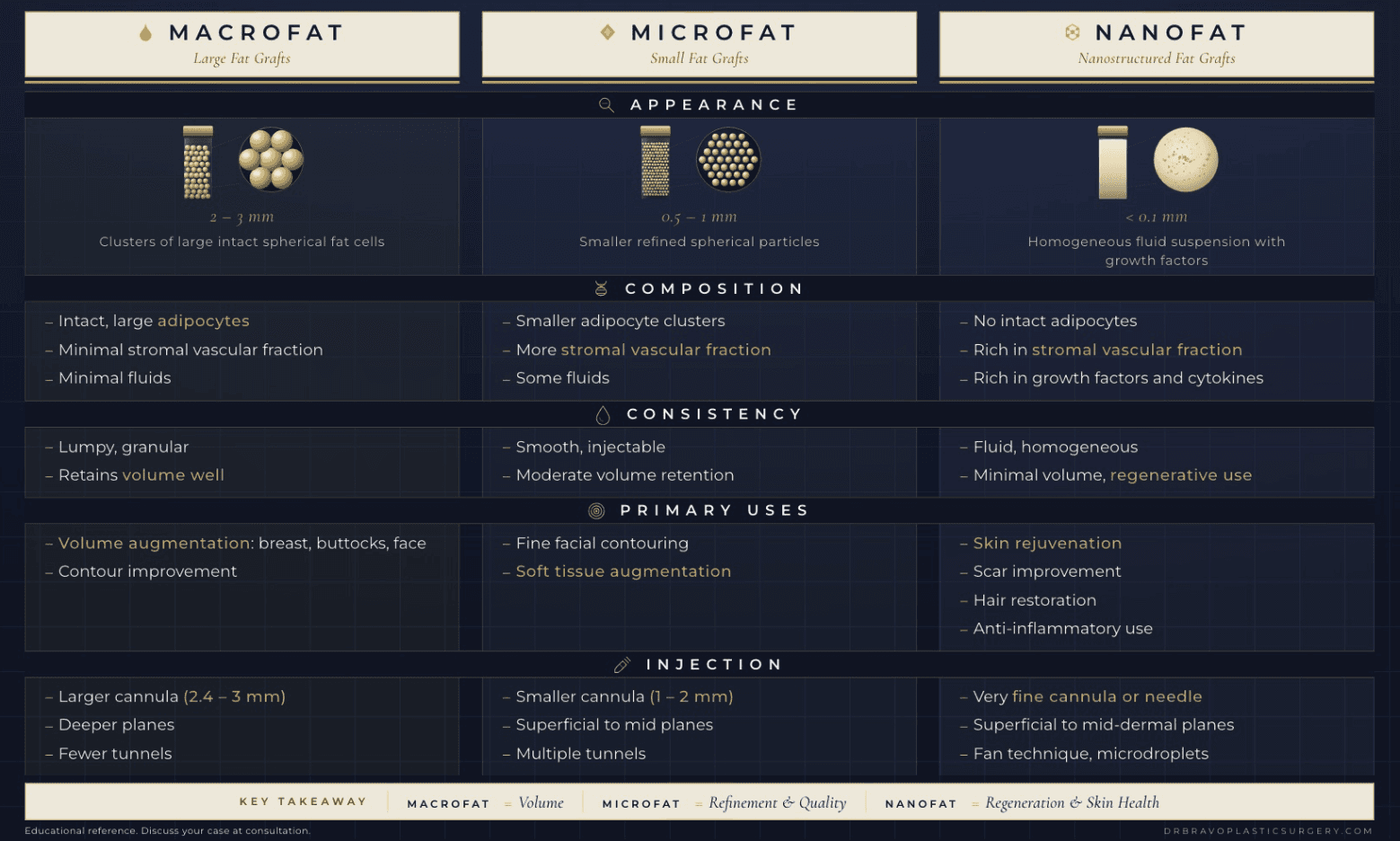
Comparison at a glance
Particle size. Macrofat: 2 to 3 millimetres. Microfat: 0.5 to 1 millimetre. Nanofat: less than 0.1 millimetre.
Composition. Macrofat: intact large adipocytes, minimal stromal vascular fraction. Microfat: smaller adipocyte clusters with more stromal vascular fraction. Nanofat: no intact adipocytes, rich in stromal vascular fraction, growth factors and cytokines.
Consistency. Macrofat: lumpy and granular, retains volume well. Microfat: smooth and injectable, moderate volume retention. Nanofat: fluid and homogeneous, minimal volume, regenerative use.
Primary uses. Macrofat: volume augmentation in breast, buttocks and face. Microfat: fine facial contouring and soft tissue augmentation. Nanofat: skin rejuvenation, scar improvement, hair restoration and anti-inflammatory use.
Injection technique. Macrofat: larger cannula (2.4 to 3 millimetres), deeper planes, fewer tunnels. Microfat: smaller cannula (1 to 2 millimetres), superficial to mid planes, multiple tunnels. Nanofat: very fine cannula or needle, superficial to mid-dermal planes, fan technique with microdroplets.
How I Choose Between Them
The decision is not about which technique is “best”. It is about which problem I am solving. If the problem is volume, the answer is macrofat. If the problem is fine facial contour, the answer is microfat. If the problem is skin quality, scars or thinning hair, the answer is nanofat. In most facial rejuvenation cases I combine two of the three in the same session: microfat for tear trough and midface volume, then nanofat layered superficially for skin quality.
Recovery and Results
The donor area is bruised and tender for one to two weeks, with a compression garment during that time. Body cases (macrofat) are swollen for two to three weeks, with the final result visible by month three to six. Facial microfat involves five to ten days of swelling and bruising and settles by month three. Nanofat has the least downtime, usually a few pink and slightly swollen days. The fat that survives the first three months is permanent for macrofat and microfat. Nanofat effects build gradually and may need maintenance every one to two years. For patients interested in optimising healing, my guide to peri-operative preparation and recovery covers what I add to the protocol.
Who Is a Candidate
A successful fat transfer needs three things: enough donor fat to harvest, stable weight at the time of surgery, and realistic expectations. Fat transfer is not a substitute for a lift when the underlying problem is skin laxity. My guide on how to choose a plastic surgeon explains what a thorough consultation should look like. These are the safety and outcome standards I follow as an active member of the American Society of Plastic Surgeons.
Frequently Asked Questions
What is the difference between microfat and nanofat? Microfat is processed to particles of 0.5 to 1 millimetre with intact fat cells, used to add fine, natural volume to the face. Nanofat is processed further until the cells themselves are broken open, leaving a regenerative fluid that improves skin quality, scars and hair but does not add volume. Microfat solves contour problems. Nanofat solves biology problems.
How long does fat transfer last? For macrofat and microfat, the 60 to 80 percent of transferred fat that establishes a blood supply in the first three months is permanent for life. For nanofat, the effects build over three to six months and may need maintenance every one to two years.
Is fat transfer better than hyaluronic acid filler? For permanence and natural integration, fat transfer wins because it becomes your own tissue. For non-surgical convenience and lower downtime, filler wins. I recommend fat transfer when the volume need is meaningful and the patient wants a long-term result, and filler for trial, touch-up or lower-commitment situations.
Discuss Your Case at a Consultation
If you are thinking about fat transfer, facial rejuvenation, body contouring or scar improvement, the best next step is a conversation. At your consultation I will assess your anatomy, listen to your goals, and explain which combination of techniques fits your case. Request a consultation through my website or contact my clinic at Elyzee Hospital in Abu Dhabi directly.
References
Tonnard P, Verpaele A, Peeters G, Hamdi M, Cornelissen M, Declercq H. Nanofat grafting: basic research and clinical applications. Plast Reconstr Surg. 2013;132(4):1017-1026. PubMed
Coleman SR. Structural fat grafting: more than a permanent filler. Plast Reconstr Surg. 2006;118(3 Suppl):108S-120S. PubMed
Mojallal A, Lequeux C, Shipkov C, et al. Improvement of skin quality after fat grafting: clinical observation and an animal study. Plast Reconstr Surg. 2009;124(3):765-774. PubMed