Two Procedures, Two Very Different Problems
In nearly every body contouring consultation I do at my practice in Abu Dhabi, the same question comes up: should I have liposuction or a tummy tuck? It is one of the most common sources of confusion in plastic surgery, and for good reason. Both procedures reshape the midsection, both can dramatically change how you look in clothes, and both are sometimes marketed as if they were interchangeable. They are not. Liposuction and abdominoplasty solve different problems, and choosing the right one (or sometimes both) depends entirely on what your body actually needs. In this guide I want to walk you through how I think about this decision, what each procedure can and cannot do, and how to know which path makes sense for you.
What Liposuction Actually Does
Liposuction is, at its core, a fat removal procedure. It uses small cannulas inserted through tiny incisions to remove unwanted fat deposits from specific areas of the body. It is a sculpting tool. When I perform liposuction in Abu Dhabi, my goal is to refine contours by removing pockets of fat that have not responded to diet and exercise. The abdomen, flanks, back, thighs, arms, and chin are common treatment areas.
What liposuction does not do is tighten loose skin or repair separated abdominal muscles. The skin will retract to some degree after fat removal, especially in younger patients with good skin elasticity, but liposuction is not a skin tightening operation. If your skin has lost significant elasticity from pregnancy, weight loss, or ageing, removing the fat underneath it may leave you with a flatter but loose abdomen. This is one of the most important distinctions to understand before choosing a procedure.
In my practice, I use ultrasound-guided liposuction for all body contouring cases. This means I operate with real-time ultrasound imaging that lets me see the exact depth and thickness of the fat layer as I work. I can visualize the cannula position at all times, which allows for more precise sculpting, safer treatment near critical structures, and a smoother final result. It is the same imaging guidance I use during my BBL procedures, and it makes a real difference in both safety and outcomes.
What a Tummy Tuck Actually Does
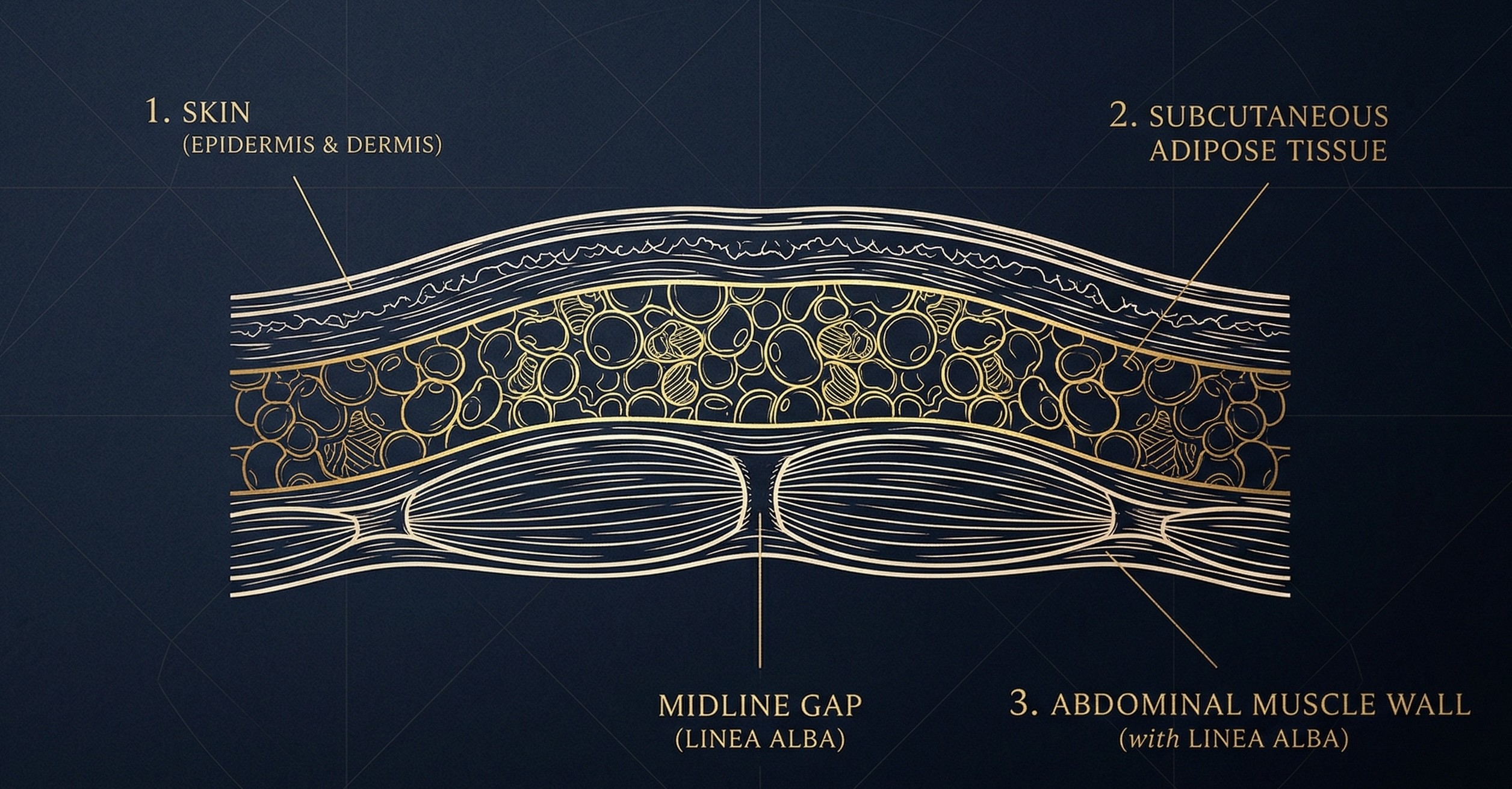
A tummy tuck, or abdominoplasty, is a much more comprehensive operation. It addresses three things that liposuction cannot touch: excess skin, weakened or separated abdominal muscles (a condition called diastasis recti), and the overall structure of the abdominal wall.
During a tummy tuck, I make an incision in the lower abdomen, remove the loose skin between the belly button and the pubic area, repair the abdominal muscles by suturing them back together along the midline, and redrape the remaining skin for a flat, smooth result. The belly button is usually repositioned to match the new contour. In most cases, I also include liposuction of the flanks and upper abdomen as part of the same procedure, which is what defines my Hourglass Abdominoplasty procedure. A tummy tuck is the only procedure that can give a patient with significant skin laxity or muscle separation a truly flat, firm abdomen. No amount of liposuction will achieve the same result if those underlying issues are present.
A Simple Decision Framework
When patients ask me how to think about this choice, I usually break it down into three questions.
1. Is your skin elastic and tight? Pinch the skin on your lower abdomen. If it springs back quickly and there is no visible looseness or stretch marks, your skin is likely in good condition. If it feels loose, hangs slightly, or has stretch marks indicating that the dermal collagen has been damaged, your skin elasticity is reduced.
2. Do you have muscle separation? Lie on your back, lift your head slightly, and feel along the midline of your abdomen above and below the belly button. If you feel a soft gap between the muscles, especially if it has been present since pregnancy, you likely have diastasis recti. This cannot be fixed with exercise or with liposuction.
3. What is your main concern? Is it stubborn fat in specific areas, or is it the overall shape and tone of your abdomen?
If your skin is tight, your muscles are intact, and your concern is isolated fat pockets, you are probably a good candidate for liposuction alone. If you have loose skin, muscle separation, or both, a tummy tuck (often combined with liposuction) is almost always the right answer. Trying to correct loose skin with liposuction is one of the most common mistakes I see in revision consultations.
The Ideal Liposuction Candidate
In my experience, the ideal liposuction patient is someone within about 10 to 15 percent of their target weight, with good skin elasticity, who has stubborn fat in specific areas that resist diet and exercise. Age is less important than skin quality. I have done excellent liposuction on patients in their fifties whose skin was still firm, and I have declined to operate on younger patients whose skin had been stretched beyond its ability to retract.
Liposuction is also a powerful tool for body proportion. Many of my patients come in not because they want to lose weight but because they want better balance: a defined waist, a smoother flank line, a flatter upper abdomen. For those goals, liposuction is often the right answer.
The Ideal Tummy Tuck Candidate
The patient who benefits most from a tummy tuck is usually someone whose abdomen has changed in a way that exercise cannot reverse. The most common situations I see are women after pregnancy, patients after significant weight loss (including those who have used GLP-1 medications such as Ozempic and Wegovy), and patients whose abdominal wall has lost integrity through ageing or genetics.
If you have had children and your lower abdomen has not returned to its pre-pregnancy state despite consistent training, the issue is almost always a combination of loose skin and stretched muscles. Both need to be addressed surgically to restore a flat contour. A tummy tuck with muscle repair is the standard of care for this presentation.
When You Need Both
In a large number of cases, the right answer is not one or the other. It is both. A tummy tuck addresses the skin and the muscles, and liposuction added to the same operation addresses the fat in the flanks, upper abdomen, and back that the tummy tuck alone cannot reach. This is the foundation of my Hourglass Abdominoplasty, which combines comprehensive liposuction of the trunk with abdominoplasty in a single staged procedure. The result is a more sculpted, three-dimensional outcome than either operation produces alone.
Combining the two procedures in the same session is safe when done by an experienced surgeon and when patient selection is appropriate. It avoids the cost and recovery of two separate operations, and the aesthetic result is usually significantly better.
Recovery: What to Expect
Recovery is one of the most practical differences between these two procedures, and it should factor into your decision.
After liposuction, most patients are walking the same day, return to desk work within around 7 days, and resume light exercise around two weeks. Swelling and bruising are normal for several weeks, and a compression garment is worn for around 4 weeks to support healing and skin retraction. There is an immediate change in the body proportions, however the final results become apparent at three to six months.
After a tummy tuck, recovery is more involved. Most patients take 2 weeks off work, avoid heavy lifting for 4 weeks, and gradually return to full exercise around 6 to 8 weeks. The first week is the most demanding because of the muscle repair, which causes tightness across the abdomen. Compression garments are worn for 4 to 6 weeks.
If your lifestyle or work cannot accommodate the longer tummy tuck recovery, that is something we should discuss in your consultation. But I always tell patients that the right operation done at the right time is better than a compromise procedure that does not give you the result you actually want.
What About Non-Surgical Alternatives?
Patients often ask about non-surgical options such as cryolipolysis, radiofrequency, or injectable fat dissolvers. These technologies have a role for very specific situations, usually for small, localised fat pockets in patients with excellent skin tone. They are not equivalent to liposuction or to a tummy tuck. They cannot remove the volume of fat that liposuction can, they cannot tighten significant skin laxity, and they cannot repair muscle separation. If you are considering surgery, it is usually because the non-surgical options are not enough. I am happy to be honest with patients when I think a less invasive approach would serve them better, but I am equally direct when surgery is the only option that will deliver the result they want.
How I Approach the Consultation
When you come in for a consultation, I take time to examine your abdomen, assess your skin quality, check for muscle separation, and listen carefully to what you want to achieve. I take measurements and before the procedure we take photographs, and I show you what each option can realistically deliver. I would rather spend an extra 30 minutes explaining why a particular procedure is or is not right for you than rush to surgery and leave you disappointed.
My role is not to sell you the biggest operation. It is to recommend the procedure that best matches your anatomy and your goals. Sometimes that is liposuction alone. Sometimes it is a tummy tuck with muscle repair. Often it is a combination of both, performed using my Hourglass Tummy Tuck approach. The right answer is the one that addresses what your body actually needs.
Next Steps
If you have been wondering whether liposuction, a tummy tuck, or a combination is right for you, the best next step is a consultation. I will assess your anatomy, walk you through the options, and help you understand what each procedure can realistically achieve. You can request an appointment through my website or contact my clinic in Abu Dhabi directly. The decision is an important one, and you deserve clear, honest guidance to make it well.